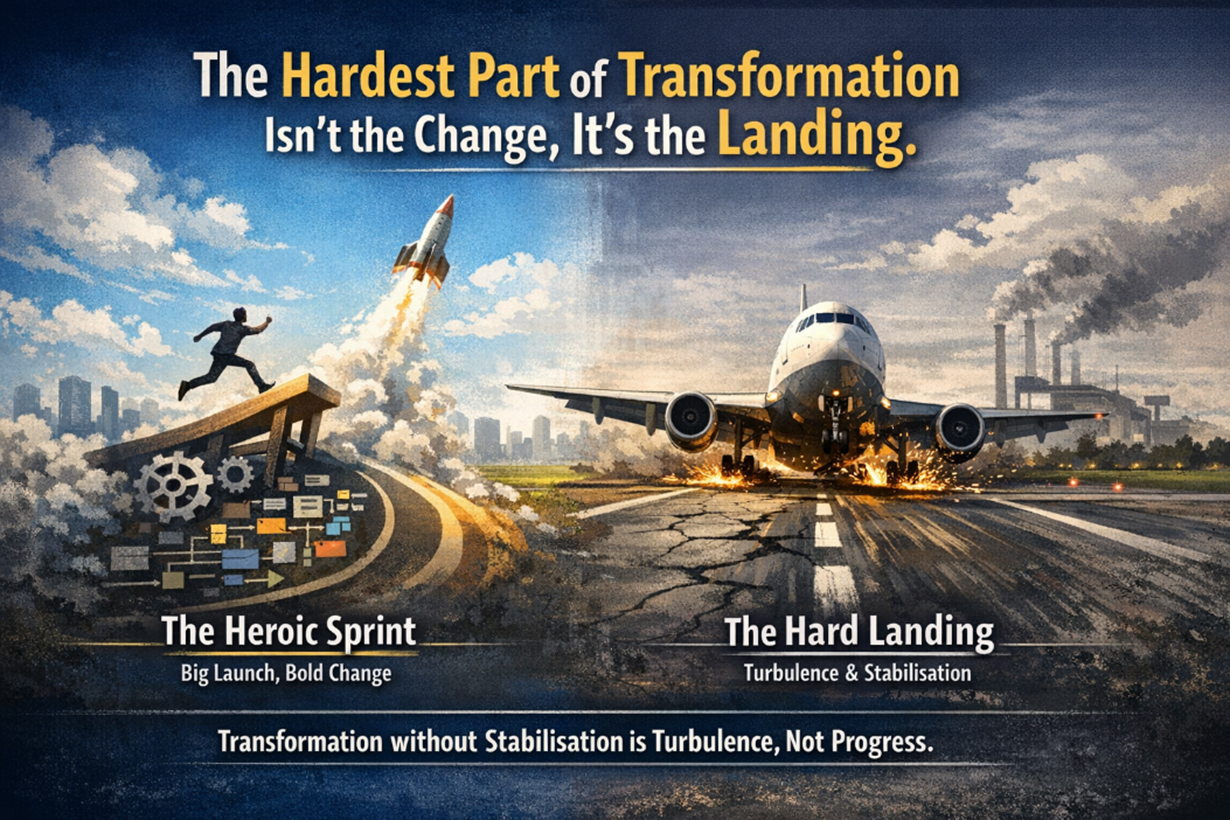
In many organisations, we still talk about transformation as if it were a heroic sprint of new operating models, shiny roadmaps or a flurry of workshops.
An unspoken belief that once the programme ‘lands’, the business will naturally settle into a better version of itself but the reality is its rarely that tidy.
In engineering led and regulated environments especially, transformation without stabilisation is not progress its turbulence. The real test of leadership is not how much change we can launch but how reliably we can land it without compromising trust, safety or long-term value.
Across 30+ years of automotive, manufacturing and consulting industry. I’ve seen the same pattern repeatedly with organisations that emerge stronger from disruption as those that treat transformation and stabilisation as one integrated discipline, not sequential phases owned by different people.
For transparency; all reflections are my own and draw on years of cross‑sector experience, not on any single engagement, employer or client.
1. Transformation is optional. Stabilisation is not.
Transformation is discretionary. Leaders choose to:
- Enter new markets.
- Adopt new technologies.
- Restructure organisations.
- Change partners, supply chains or ownership.
Stabilisation is different. Once change begins, stability becomes a duty where Customers, regulators, employees and suppliers don’t experience ‘a programme’, they experience whether the organisation still works.
In safety‑critical and regulated sectors, that duty is non negotiable. You cannot ask a regulator, a customer or the public to ‘bear with us while we transform’.
Every transformation decision therefore carries an implicit question:
‘Can we keep this system safe, reliable and governable while we change it?’
If the honest answer is ‘not yet’, the transformation is not ready. Even though how compelling the business case may look in isolation.
2. Stabilisation starts long before the first slide deck
Too often, stabilisation is treated as ‘post go live’ clean up:
- Fix the defects.
- Calm the customers.
- Patch the processes.
- Replace a few leaders.
By that point, the damage is already done.
In robust programmes, stabilisation is designed in from day one:
Operational guardrails
- What is non negotiable (safety, compliance, service levels and/or covenants)?
- Which red lines automatically trigger a pause or escalation?
Transitional governance
- Who is accountable for the system while it is moving?
- How does the board see risk and performance during change, not just at gateways or milestones?
Capacity and resilience planning
- Can we run the business and change it simultaneously?
- Where are we already and how will we protect those areas?
Exit criteria from ‘transformation mode’
- What evidence demonstrates the new way of working is stable?
- How accountability is formally transferred into ‘business as usual’?
When these questions are answered early, stabilisation becomes a managed progression and not an emergency response.
3. The hidden cost of ‘permanent transformation’
Many organisations now describe themselves as being in ‘continuous transformation’. Sometimes this is necessary but often this can quietly degrade into never stabilised.
Warning signs:
- Teams are always ‘in transition’ and nothing truly beds in.
- Governance focuses on programme updates, not operational performance.
- Standards and documentation lag behind reality.
- The organisation speaks in the future tense ‘When X is finished, we will…’.
The cost isn’t just fatigue or turnover. It is erosion of trust:
- Customers treat commitments as indicative.
- Regulators question whether control environments are truly in place.
- Boards see confidence on slides but instability on the ground.
In engineering and safety‑critical systems, this is especially dangerous. When everything is in flux, emerging risks become harder to see until they are uncomfortably close.
Stabilisation is not resistance to change. It is the firm ground from which meaningful change can continue.
4. What stabilising leadership actually does
Leaders who excel at both transformation and stabilisation tend to behave differently.
- They define steady state as clearly as target state. Roles, accountabilities, KPIs, tolerances and escalation paths are explicit.
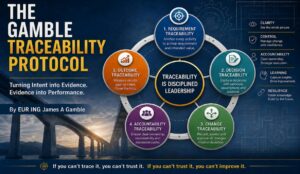
- They insist on traceable decisions. Compromises are documented so the organisation can respond intelligently when issues surface later.
- They invest in middle management and technical leadership. Stabilisation lives with those who schedule shifts, approve work, sign off tests and speak to customers daily.
- They treat the emotional journey as real work. Anxiety, grief and resistance are normal responses to disruption, not performance defects.
- They know when to stop. Not every clever idea belongs in the current release. Deferral is stewardship not failure.
5. Engineering lessons for non engineering transformations
Engineering disciplines teach a simple rule ‘assume things will fail and design so failure is visible, contained and recoverable’.
Applied to transformation, that means:
- Anticipating failure modes of the change itself (people, suppliers, IT and regulation).
- Creating ‘test like’ environments for new ways of working.
- Using standards and independent review not as bureaucracy but as ‘infrastructure for trust’.
We should bring the same rigour to changing a business as we would to changing a safety‑critical component.
6. From change projects to stewardship
Ultimately, transformation and stabilisation are not techniques. They are acts of stewardship.
Senior leaders and boards are guardians of:
- Customers safety and confidence.
- Employees livelihoods and development.
- Investors capital and trust.
- The organisations licence to operate.
Seen through that lens, every transformation tests character:
- Will we slow down when stabilisation demands it?
- Do our governance choices protect people from the consequences of our own ambition?
- Years later, will the organisation be more resilient not just more efficient?
The strongest leaders treat transformation and stabilisation as one continuous mandate. They change what must be changed, stabilise what must be stable and remain accountable for the human and ethical consequences of both.
7. 5‑point stabilisation checklist
A simple stabilisation checklist we can use as leaders.
Before declaring any major transformation ‘done’, we should ask five questions:
- Guardrails: Have we clearly defined the non negotiables (safety, compliance, service levels and covenants), are the red lines that trigger a pause or escalation understood at every level?
- Ownership: Is it unambiguous who owns stability and safety in the changed system, not just who owned delivery of the programme?
- Visibility: Can the board and senior leaders see operational performance and risk clearly during the change, not just programme status and milestones?
- Capacity: Can we demonstrably run the business and change it at the same time, without relying on sustained heroics from a few critical people?
- Exit criteria: Do we have evidence that the new way of working is stable and has accountability been explicitly handed over as ‘business as usual’, through roles, standards and documentation being up to date?
If any of these questions can’t be closed, the work of stabilisation is not yet finished and requires further clean up.
Questions for reflection
If we are leading, sponsoring or governing a major transformation:
- What does ‘stabilised’ mean to yourself and who would declare it based on what evidence?
- Where might parts of the organisation be stuck in permanent transformation mode?
- Which safeguards in governance, people, process and technology are non negotiable?
- Who is accountable not just for delivery but for safety and stability during the change?
If we can answer those questions clearly and act on them consistently, transformation stops being a strain and becomes what it was meant to be ‘disciplined, responsible stewardship’.
James Gamble
02/02/2026