Over the past decade, smart manufacturing and Industry 4.0 have become central to industrial strategy. Digital twins, connected systems, advanced analytics, simulation and AI all offer significant potential to improve efficiency, quality, flexibility and decision making.
This is an important direction of travel for manufacturing.
However, the organisations that realise the greatest value are usually those that approach digital transformation in the same way they approach any other serious engineering challenge. Through structure, clarity and operational discipline.
After more than 30 years in advanced engineering, manufacturing transformation, process optimisation and automotive development. I have seen that technology creates the strongest results when it is applied to a well understood industrial need and integrated into a stable well engineered operating system, supported by stable processes, capable teams and reliable data.
The issue is rarely whether the technology is valuable. The real differentiator is how well it is integrated into the manufacturing system.
Industry 4.0 delivers best when built on strong foundations
A common challenge in digital transformation is sequence.
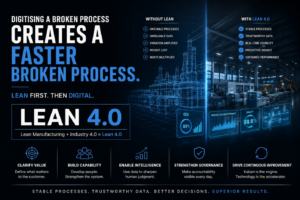
In some cases, organisations invest in platforms, dashboards, automation or data capture before the underlying process has been fully understood, stabilised or optimised. When that happens, the benefits are often slower to materialise, not because the tools are incorrect but because the operating environment is not yet ready to extract their full value.
This can show up in many ways:
- Digital tools being applied to processes that still contain avoidable variation.
- Large volumes of data being collected without a clear decision making purpose.
- Systems being introduced before standards and operating discipline are fully embedded.
- Reporting visibility improving without a corresponding step change in flow, quality or responsiveness.
In those situations, digital capability can make existing issues more visible but visibility alone does not resolve them.
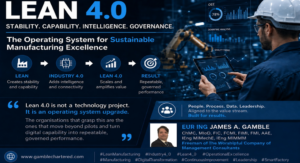
That is why the strongest Industry 4.0 programmes tend to begin with engineering fundamentals and then use digital tools to accelerate, connect and scale improvement.
Engineering fundamentals still underpin smart manufacturing
Long before the current wave of digital transformation, high performing factories were built on sound engineering and operational principles. That has not changed.
In practice, many of the biggest gains in manufacturing performance still come from areas such as:
- Process mapping and capability analysis.
- Bottleneck identification and constraint management.
- Line balancing and workflow optimisation.
- Standardised work and robust operating procedures.
- Quality planning and failure mode avoidance.
- Lean disciplines such as 5S, TPM and continuous improvement.
These are not alternatives to Industry 4.0. They are what allow Industry 4.0 to succeed.
A stable, well understood process gives digital technologies something meaningful to enhance. It creates the environment in which simulation, digital twins, connected monitoring, advanced analytics and automation can contribute measurable operational value.
Technology creates the most value when it solves a defined industrial problem
The most effective digital manufacturing initiatives I have seen usually begin with a clear operational question.
Not where can we use more technology, but rather:
- Where is the constraint in the system?
- Where is variation affecting quality or throughput?
- Where would better visibility improve decisions?
- Which assets carry the greatest operational risk?
- Where can simulation or digital validation reduce cost, time or disruption?
When technology is selected in that context, it becomes a practical enabler of performance.
Examples may include:
- Simulation tools used to optimise layouts before capital investment.
- Digital monitoring deployed at bottlenecks to improve cycle time stability.
- Predictive maintenance focused on high value or risk assets.
- Data led quality systems improving traceability and root cause resolution.
- Automated inspection improving repeatability in precision environments.
- Digital twins supporting product, process and production validation earlier in the lifecycle.
In each case, the technology supports a defined engineering objective. It strengthens execution rather than replacing judgement.
That is where smart manufacturing becomes commercially meaningful.
Data matters most when it is connected to operating reality
One of the most important aspects of digital transformation is the treatment of industrial data.
Manufacturers already manage drawings, specifications, tooling, standards and product definitions with care and discipline. Increasingly, data should be viewed in a similar way as an engineered asset that supports decisions across the value chain.
Therefore, data must be:
- Structured.
- Relevant.
- Trustworthy.
- Connected across systems.
- Aligned to operational priorities.
When data is organised and maintained in that way, it becomes far more valuable. It can support simulation, digital twins, forecasting, maintenance strategy, quality analysis, root cause investigation and faster decision making.
That is when digital infrastructure begins to translate into operational capability.
People, process and technology must move together
Factories are interdependent systems and digital transformation is never only a technology question.
Success depends on the alignment of three elements:
- People through capability, engagement and ownership.
- Process through stability, flow and standardisation.
- Technology through targeted solutions applied to real industrial needs.
When digital tools are introduced without enough focus on training, leadership, adoption and operating discipline. The result is often slower uptake and less value than expected.
When those elements are aligned, transformation becomes more scalable, more measurable and more sustainable.
A practical view of Industry 4.0
This is not an argument against advanced technology. Quite the opposite.
AI, simulation, connected systems, digital twins, robotics and analytics all have an important role to play in the future of manufacturing. Applied well, they can improve visibility, responsiveness, flexibility, quality and asset utilisation.
However, the strongest outcomes usually come when they are introduced as part of an engineering led transformation journey.
In other words:
- Understand and stabilise the process.
- Define the business problem clearly.
- Build the right data and system foundations.
- Apply technology where it can solve something meaningful.
- Support implementation through people, leadership and operational discipline.
That is how smart manufacturing moves from concept to measurable performance.
Looking ahead
As supply chains become more complex and competitive pressure increases, investment in digital capability will continue.
The manufacturers that will lead are unlikely to be those that simply deploy the most software.
They will be the ones that combine:
- Strong engineering fundamentals.
- Clear operational priorities.
- Robust data foundations.
- Targeted use of digital tools.
- Disciplined execution across people, process and technology.
Smart manufacturing is not just about building a more connected factory. It is about building a more capable one.
For myself, that is where the real opportunity lies. Using digital capability to strengthen industrial performance in a structured, practical and commercially relevant way.
For transparency, these reflections are my own and draw on years of cross-sector experience, not on any single engagement, employer or client.
James Gamble
13/04/2026