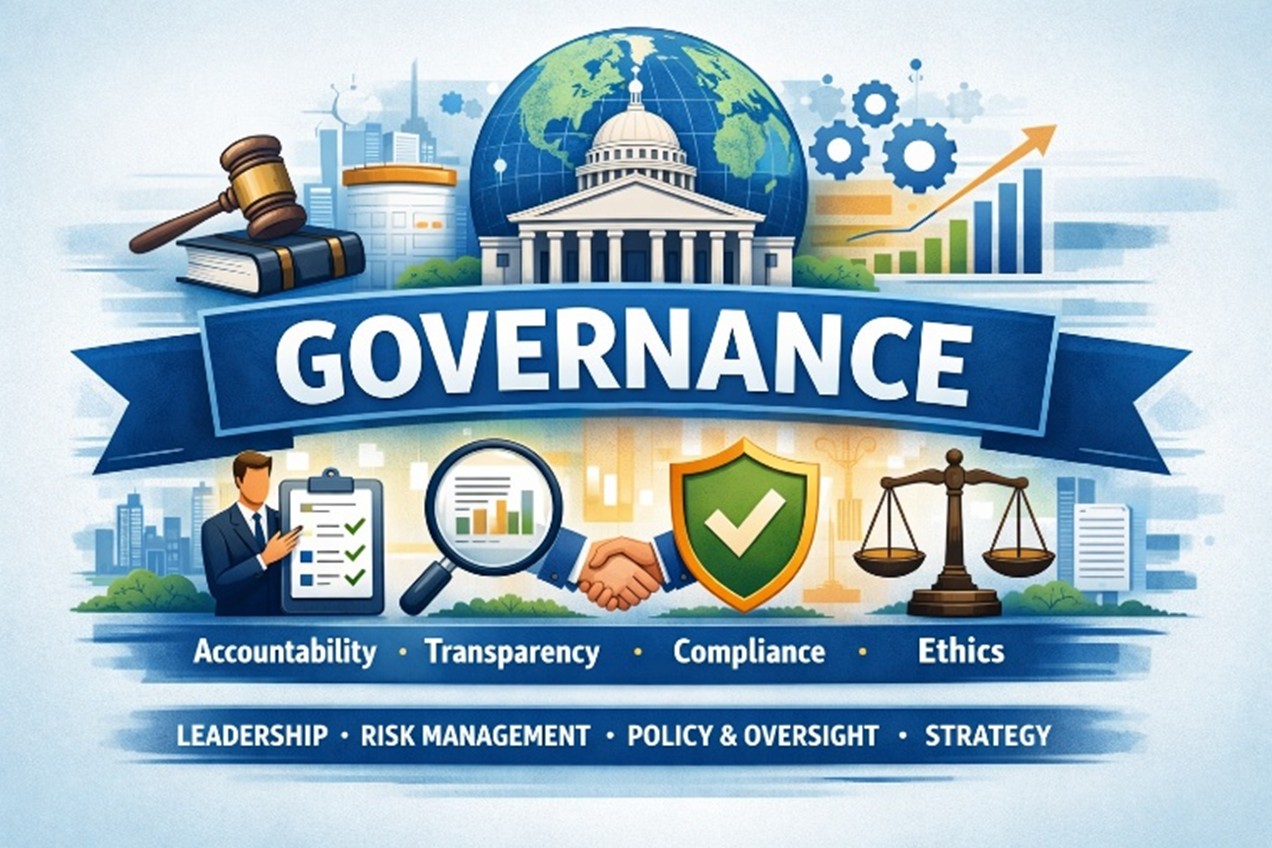
Governance is not paperwork, it is the operating system that determines whether an organisation performs with consistency, integrity and strategic clarity.
When leaders treat governance as a living system rather than an administrative burden, it becomes a multiplier of disciplined speed, resilience and long‑term value.
Governance as the Operating System of Sustainable Performance
Many organisations still equate governance with bureaucracy, compliance or a brake on innovation. In reality, governance defines:
- How authority is exercised.
- How decisions are made.
- How risk is managed.
- How accountability is enforced.
Governance is the architecture that enables organisations to scale without losing control.
High performing organisations understand that governance is not about slowing things down, it is about ensuring that speed is disciplined, not uncontrolled.
Governance vs Management a Critical Distinction
Governance and management are often mixed, yet they serve fundamentally different purposes:
- Governance determines what must be achieved, why it matters and within what boundaries.
- Management is the strategy that determines how it is achieved.
Governance sets the direction, risk appetite, ethical parameters and performance expectations. Management performs within that framework.
When these roles blur, organisations either drift strategically or become operationally constrained. A clear separation is essential for strategic logic.
Where Governance Really Fails on The Interfaces
Governance rarely collapses inside a function. It collapses at the interfaces where accountability is shared, decision rights are blurred and assumptions replace alignment.
Most governance failures do not originate from a missing policy or an absent process. They emerge in the grey zones:
- Programme to function.
- Engineering to commercial.
- Supplier to OEM.
- Board to Executive.
These interfaces are where risk does hide, where decisions slow and where escalation becomes political rather than procedural. If governance is not explicitly designed for the interfaces, it will fail precisely where the organisation is most vulnerable.
This is the difference between governance that exists on paper and governance that actually works.
The Five Pillars of Effective Governance
Across industries and organisational scopes, mature governance systems consistently demonstrate five characteristics:
1. Clarity of Accountability.
Every material decision must have a clearly identified owner. Ambiguity leads to duplication, delay and unmanaged risk.
RASIC structures, terms of reference and explicit mandates are foundational to organisational discipline.
2. Decision Rights Architecture.
Governance is fundamentally about decision velocity and quality. Effective organisations define:
- Which decisions sit with the Board.
- Which are delegated to executive leadership.
- Which are embedded within operational functions.
Escalation thresholds must be defined before a crisis, not during one.
3. Risk Oversight and Control Maturity.
Governance and risk management are inseparable. Mature organisations:
- Define risk appetite formally.
- Align assurance mechanisms to critical risks.
- Separate first line ownership from independent oversight.
Risk reporting should inform decisions, not simply satisfy compliance requirements.
4. Performance Transparency.
Governance must link strategy to measurable outcomes. This requires:
- KPIs aligned to strategic intent.
- Independent review of performance data.
- Willingness to confront underperformance early.
Ambiguity erodes trust whereas transparency builds resilience.
5. Ethical and Cultural Anchoring.
Policies will not govern behaviour, culture does. Effective governance embeds:
- Enforced codes of conduct.
- Leadership behaviours aligned to stated values.
- Psychological safety to surface concerns early.
Without cultural alignment, governance becomes performative rather than protective.
Governance as a Value Multiplier
Strong governance directly correlates with:
- Capital efficiency.
- Reduced systemic risk.
- Improved stakeholder confidence.
- Higher long‑term enterprise value.
Investors and regulators increasingly view governance maturity as a proxy for strategic reliability. Weak governance often remains invisible during stable periods but becomes painfully visible during stress events.
Common Governance Failure Modes
Even sophisticated organisations fall into predictable traps:
- Over centralised decision bottlenecks.
- Committees without real authority.
- Excessive reporting with insufficient insight.
- Informal ‘shadow governance’ structures.
- Delegated authorities that fail to evolve with scale.
As complexity increases, governance needs to adapt. Static structures eventually become points of friction or failure.
Practical Steps to Strengthen Governance
Leaders seeking to enhance their governance frameworks can start via:
- Conducting a formal governance maturity assessment.
- Mapping all material decision rights and escalation triggers.
- Testing crisis governance protocols through simulation.
- Reviewing committee mandates and effectiveness.
- Aligning risk appetite statements with actual behavioural incentives.
Governance is not static documentation, it is a living and evolving system.
The Strategic Imperative
At its core, governance is about disciplined stewardship. It protects stakeholders, enables performance and ensures organisations can scale with confidence.
In volatile markets, governance is not a constraint it is the competitive advantage.
For transparency; all reflections are my own and draw on years of cross-sector experience not on any single engagement, employer or client.
James Gamble
24/03/2026