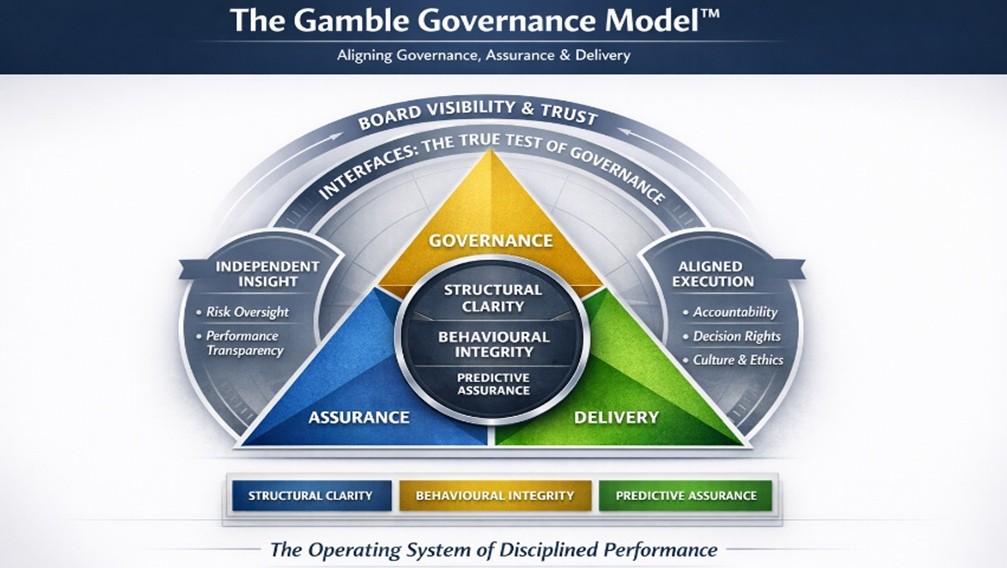
Building on earlier reflections that governance is the hidden architecture behind scalable performance. The ‘Gamble Governance Model’ translates philosophy into a structured system with aligning governance, assurance and delivery into a single disciplined operating model.
Governance is not paperwork. It is the operating system that determines whether an organisation performs with consistency, integrity and strategic clarity. When leaders treat governance as a living system rather than an administrative burden, it becomes a multiplier of disciplined speed, resilience and long-term value.
Governance as the Operating System of Sustainable Performance
Many organisations still equate governance with bureaucracy, compliance or a brake on innovation. In reality, governance defines:
· How authority is exercised.
· How decisions are made.
· How risk is managed.
· How accountability is enforced.
Governance is the architecture that enables organisations to scale without losing control. High performing organisations understand that governance is not about slowing things down, it is about ensuring that speed is disciplined and not uncontrolled.
Governance vs Management, A Critical Distinction
Governance and management are often mixed, yet they serve fundamentally different purposes:
· Governance determines what must be achieved, why it matters and within what boundaries.
· Management determines how it is achieved.
Governance sets direction, risk appetite, ethical parameters and performance expectations. Management performs within that framework. When these roles blur, organisations either drift strategically or become operationally constrained. A clear separation is essential for strategic logic.
Where Governance Really Fails, The Interfaces
Governance rarely collapses inside a function. It collapses at the interfaces. Where accountability is shared, decision rights are blurred and assumptions replace alignment.
Most governance failures do not originate from a missing policy or an absent process. They emerge in the grey zones:
· Programme to function.
· Engineering to commercial.
· Supplier to OEM.
· Board to Executive.
These interfaces are where risk hides, where decisions slow and where escalation becomes political rather than procedural. If governance is not explicitly designed for the interfaces, it will fail precisely where the organisation is most vulnerable.
This is the difference between governance that exists on paper and governance that actually works.
‘The Gamble Governance Model’
At its core, my model aligns Governance, Assurance and Delivery into a single, coherent system that boards and executives can trust.
It is built on three pillars:
1. Structural Clarity
Governance must be unambiguous. This means:
· Clear accountabilities.
· Defined decision rights.
· Transparent escalation pathways.
· Standards that are understood and not just published.
Structural clarity removes friction and prevents the shadow governance that emerges when formal structures fail.
2. Behavioural Integrity
Governance succeeds or fails on behaviour. The model focuses on:
· Leadership discipline.
· Consistency of decision making.
· Psychological safety for escalation.
· Cultural signals that reinforce accountability.
When behaviours align with intent, governance becomes a living system rather than a procedural one.
3. Predictive Assurance
Traditional assurance tells us what went wrong. Modern assurance must tell us what will go wrong unless action is taken.
This requires:
· Forward looking indicators.
· Independent challenge.
· Evidence based insight.
· A direct line of sight from the board to the work.
Predictive assurance is the difference between governance that reacts and governance that prevents.
Mapping the Model to Governance Maturity
‘The Gamble Governance Model’ operationalises within the five pillars of effective governance:
| Earlier Pillars | Gamble Governance Model Equivalent |
| Clarity of Accountability | Structural Clarity |
| Decision Rights Architecture | Structural Clarity |
| Risk Oversight & Control Maturity | Predictive Assurance |
| Performance Transparency | Predictive Assurance |
| Ethical & Cultural Anchoring | Behavioural Integrity |
This alignment ensures continuity between conceptual governance and practical application.
Governance as a Value Multiplier
Strong governance directly correlates with:
· Capital efficiency.
· Reduced systemic risk.
· Improved stakeholder confidence.
· Higher long-term enterprise value.
Investors and regulators increasingly view governance maturity as a proxy for strategic reliability. Weak governance often remains invisible during stable periods but becomes painfully visible during stress events.
Practical Steps to Strengthen Governance
Leaders seeking to enhance their governance frameworks can start by:
· Conducting a formal governance maturity assessment.
· Mapping all material decision rights and escalation triggers.
· Testing crisis governance protocols through simulation.
· Reviewing committee mandates and effectiveness.
· Aligning risk appetite statements with behavioural incentives.
Governance is not static documentation, it is a living and evolving system.
The Strategic Imperative
At its real core, governance is all about disciplined stewardship. It protects stakeholders, enables performance and also ensures organisations can scale with confidence.
In volatile markets, governance configured for scale is not a constraint but is the competitive advantage.
For transparency; all reflections are my own and draw on years of cross-sector experience not on any single engagement, employer or client.
James Gamble
07/04/2026