Every critical system we rely on today, from the aircraft we board to the energy grid that powers our homes, ultimately depends on trust. Not just personal trust, but institutional trust in decisions made under risk.
In complex, high consequence systems, trust can no longer be intuitive. It needs to be evidenced and governed.
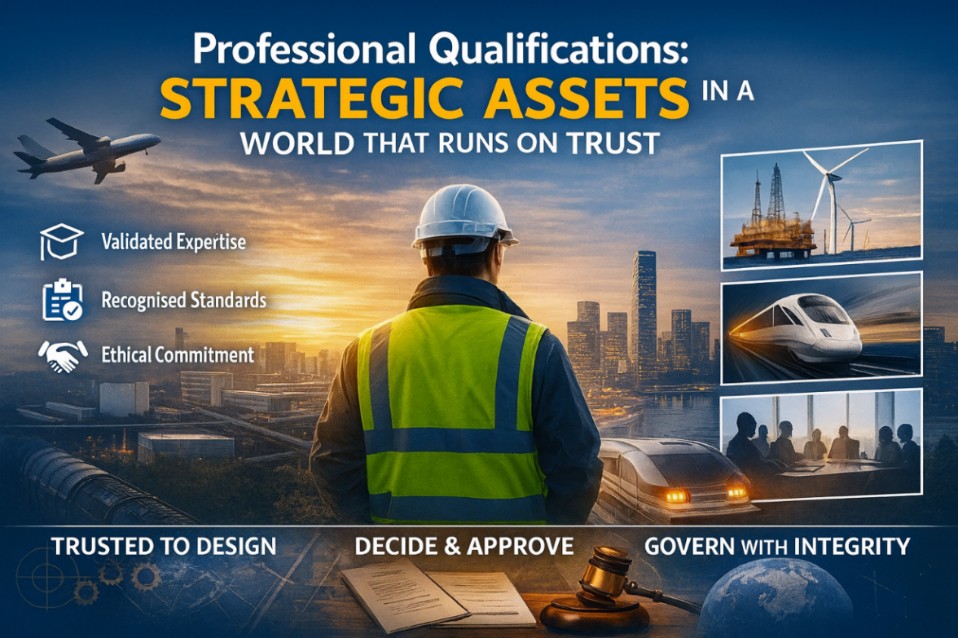
In a world where credibility underpins investment, regulation and public confidence. Formal professional qualifications function less as personal credentials and more as governance infrastructure. They determine who can be trusted to design, decide, approve and govern systems that carry risk in an increasingly complex and regulated environment.
Professional qualifications are far more than letters after (or before) a name. They are structured, externally validated and independently audited proof that an individual can deliver high stakes work repeatedly, under pressure and in line with recognised standards.
In effect, they provide externally assured evidence that critical decisions are being made by people whose judgement has been independently tested.
For engineers, technologists and leaders across disciplines, professional qualifications have emerged as key assets for individuals, organisations and industries.
Professional Qualifications as Trust Mechanisms
At their core, professional qualifications act as mechanisms. For organisations, they provide confidence that individuals entrusted with authority are:
- Assessed against recognised standards.
- Independently reviewed.
- Held to ongoing ethical and professional obligations.
In safety critical or high consequence domains such as mobility, energy, infrastructure, manufacturing and healthcare technology. Trust is essential.
Boards, regulators, investors and clients are increasingly looking for credentials that withstand external scrutiny. A professional title signals:
- Professional rigour.
- Adherence to recognised standards.
- Consistent, high‑quality outcomes.
This is why professional qualifications increasingly appear in tenders, framework agreements and governance structures. As they reduce perceived risk by replacing assumption with assurance.
In many regulated programmes, named chartered or professionally registered individuals are now required for technical sign‑off, safety assurance or governance roles, not as a preference, as a condition of acceptance.
Accessible to Anyone
A common misconception is that professional qualifications are reserved for traditional or academic elites. This is not true.
In reality:
- Frameworks exist for technical, managerial, operational and strategic roles.
- Experiential learning is widely recognised alongside formal education.
- Progression is modular and achievable across an entire career.
With the right guidance, almost any committed professional can map a credible route from early career to advanced recognition.
Enabling Innovation through Disciplined Practice
Innovation without discipline produces ideas, not outcomes. What turns innovation into scalable, investable capability is disciplined practice under recognised standards.
Professional standards provide the structure that allows innovation to survive scale, scrutiny and consequence. They embed:
- Systems thinking.
- Robust design, verification and validation.
- Documented decision making.
- Traceability and accountability.
These are the foundations that allow innovation to scale, from concept to production, from laboratory to field and from prototype to portfolio.
Through operating within recognised professional frameworks, individuals are more likely to:
- Challenge assumptions using structured methods.
- Apply best practices from adjacent sectors.
- Anticipate failure modes and mitigate them early.
- Integrate safety, sustainability and quality by design.
Professional qualifications do not constrain innovation; they stabilise it and make it deployable at industrial scale.
For transparency: all reflections are my own and draw on years of cross‑sector experience, not on any single engagement, employer or client.
From Engineer to Industrial Leader
Technical depth alone rarely qualifies for board level or system level influence.
As systems become more interconnected and consequences more severe, influence increasingly follows trust rather than hierarchy.
Advanced professional qualifications, particularly chartered and fellowship level recognition, help bridge the gap between specialist and strategic leader by:
- Demonstrating sustained contribution to a profession or industry.
- Validating judgement in complex, high consequence decisions.
- Evidencing ethical, accountable practice over time.
- Providing exposure to multidisciplinary and cross‑sector perspectives
For organisations, leaders with recognised professional standing bring:
- Credibility with regulators, investors and strategic partners.
- The ability to translate between technical, commercial and policy domains.
- Confidence that governance decisions are rooted in both expertise and ethics.
For individuals, structured professional progression is often the route from practitioner to industrial leader as trusted not just to execute, but to shape direction at system level.
Mobility as a Strategic Capability
One of the most underestimated strategic benefits of professional qualifications is the mobility they enable.
In a world of non‑linear careers, industry convergence and global programmes, professional recognition turns expertise into a portable asset.
Career Mobility (Across Roles and Industries)
Professional qualifications act as a common currency of competence. They make it easier to:
- Move between roles (specialist to technical authority to governance).
- Transition across adjacent sectors (automotive, rail, aerospace, energy, etc.).
- Avoid being constrained by a job title rather than true capability.
They are therefore a powerful hedge against industry cycles and structural change.
Organisational Mobility (Between Companies)
Employers sometimes mistake each other’s internal job architectures, but they do understand recognised credentials. Professional qualifications:
- Shorten the trust building phase when joining a new organisation.
- Allow rapid benchmarking by HR, hiring managers and technical authorities.
- Often place individuals directly onto higher responsibility tracks.
As such, they can smooth lateral moves as effectively as vertical progression.
Geographic and Global Mobility
This is where professional qualifications become strategically their own:
- Many bodies operate internationally or via reciprocal recognition.
- Global programmes require named, competent professionals for sign‑off.
- In international settings, post nominals establish credibility independent of corporate hierarchy.
Professional qualifications do not just validate what you know; they change where you are allowed to operate.
Concrete Benefits to the Individual
For individuals, the value proposition is multi-dimensional:
- Skill validation and targeted development.
- Differentiation in competitive markets.
- Progression across technical and leadership tracks.
- Improved marketability and financial upside.
- Structured continuous professional development (CPD).
- Access to networks, standards bodies and influence.
- Eligibility to hold formal responsibility and sign‑off roles.
Benefits to Organisations and Industries
While individuals hold the titles, organisations and industries capture systemic value:
- Higher baseline competence.
- Stronger safety and quality culture.
- Improved client and regulator confidence.
- More robust succession planning.
- Better alignment with assurance and governance expectations.
Industries with strong professional cultures tend to be safer, more resilient and better able to adapt to disruption.
Summary
Professional qualifications are the infrastructure for trust, the architecture for capability and platforms for leadership and mobility.
- For individuals, they provide resilience and global optionality.
- For organisations, they reduce risk and increase credibility.
- For industries and society, they help ensure that complex systems are designed and governed by people who are demonstrably competent and ethically grounded.
In a world defined by complexity and consequence, trust is the ultimate currency and professional qualifications are a core part of the architecture that sustains it.
If we want safer systems and stronger governance, we must continue to invest in the professional capability required to uphold that responsibility.
However, professional qualifications are not the only source of good judgement. Although, in the context of high consequence systems, they do remain one of the few mechanisms that can be independently evidenced and governed.
Therefore, my question is where within organisations might trust still be assumed rather than formally assured and what risk does that quietly introduce?
James Gamble
12/01/2026