In many organisations, management and manager are used as if they mean the same thing.
They do not.
They describe two different but interdependent ideas. If we want stronger leadership, clearer accountability and more predictable performance. It is worth separating the discipline of management from that of the role of the manager.
Management: The System of Work
Management is a discipline, a structured set of activities that enable an organisation to function effectively. It is the framework through which goals are defined, resources aligned and performance monitored.
In my previous article, Good Management is Quietly Powerful, I described management as the operating system of the organisation. The structured mechanisms that translate strategy into a coordinated execution.
The standard management cycle still underpins any successful operation:
Planning: Defining objectives and the roadmap to achieve them.
Organising: Structuring teams, resources and responsibilities.
Leading: Guiding people, maintaining alignment and enabling performance.
Controlling: Monitoring progress, managing risk and ensuring standards are met.
The essential point: Management exists independently of any individual. It is the architecture that keeps an organisation coherent, coordinated and capable of delivering outcomes whether or not a particular manager is present.
In practice this system shows up through governance, planning cycles, decision structures, performance metrics and operating cadence. These are the mechanisms that allow organisations to convert strategy into sustained execution.
The Manager: The Human Enabler
If management is the system, the manager is the person accountable for applying it.
A manager is the practitioner who turns organisational intent into operational reality. They do more than oversee work, they enable it.
Effective managers:
- Translate strategy into day‑to‑day actions.
- Resolve issues and maintain momentum.
- Communicate expectations and provide context.
- Develop capability, confidence and cohesion in others.
In short, management is the methodology with managers being the practitioners who implement.
Distinguishing the Two
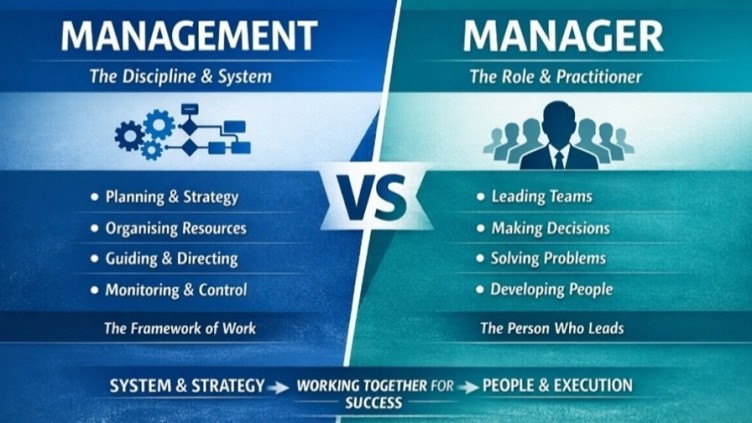
A simple way to view that distinction:

Both are essential but they are not identical.
Where They Converge
Although distinct, the two are inseparable. The effectiveness of management depends heavily on the capability of those applying it.
High performing managers:
- Apply management principles consistently.
- Build resilience into systems.
- Create clarity, reliability and trust across teams.
Conversely, managerial capability strongly influences how effectively even sophisticated systems operate.
We can design the best management system in the world but if managers aren’t properly supported or equipped, the gears may eventually grind to a halt.
The Modern Manager: Beyond Supervision
The role of the manager has evolved significantly.
Today’s managers must operate as:
Leaders: Providing clarity, direction and purpose.
Coaches: Developing people and strengthening internal capability.
Strategic Connectors: Linking daily work to broader organisational goals.
Change Agents: Helping teams navigate uncertainty, transformation and disruption.
Supervision alone is no longer enough. The modern manager must activate the management system in a way that is human, adaptive and forward looking.
Closing Reflection
The distinction is simple but powerful:
Management is the framework. Managers are the people who activate it.
Organisations thrive when they invest in both:
- Robust, well designed management systems.
- Managers who understand the discipline and the art of leading through those systems.
The question for most organisations is therefore not simply how many managers do they have, the more important question is:
‘How can organisations both strengthen their management systems and better support the managers working within them?’
For transparency; all reflections are my own and draw on years of cross-sector experience not on any single engagement, employer or client.
James Gamble
16/03/2026