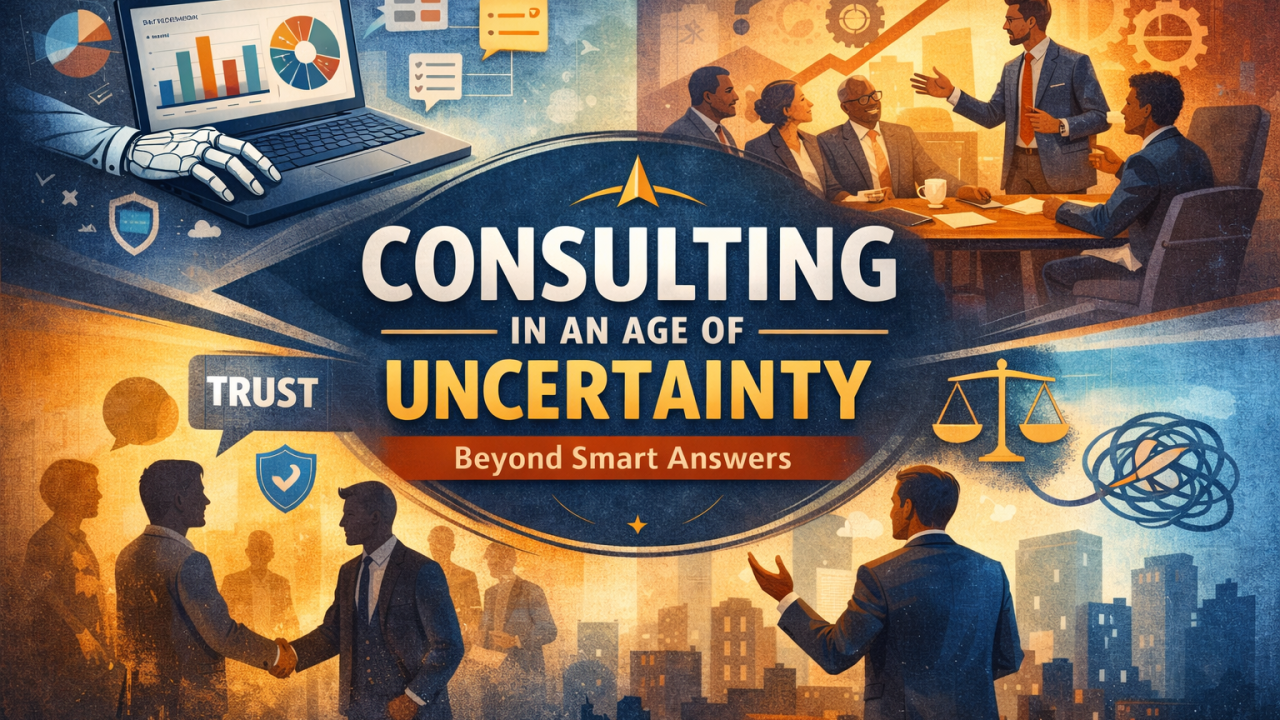
To me, consulting has always been about helping organisations make better decisions than they could make alone. Yet, over 2025 many of the ‘smart answers’ that once justified major projects are now just a browser tab away:
· Frameworks have become generic.
· Benchmark data is everywhere.
· AI can generate a deck in seconds.
If information is no longer the real differentiator, what are clients paying for?
In short, they are paying for the judgment, alignment and resolution that sits within the core of consulting.
From content to context
For years consulting utilised content from models, methodologies and best practice. The promise was ‘we’ve seen this before, so we know the answer’.
However today:
· Clients can access most of the same frameworks.
· Best practice is widely shared and often copied.
· Boards care less about generic playbooks and more about contextual thinking.
Therefore, high value consultants don’t ask ‘Which framework fits?’ Instead they ask, ‘What matters here with these resources and under these constraints?’
The value isn’t knowing everything. It’s knowing which 5% actually matters.
Consulting is a contact sport
Across global programmes, I’ve seen the same pattern of the hardest work not being the analysis but the alignment.
Most executives aren’t paying for reports anymore. As they know:
· Many reports have a short shelf‑life.
· The problem is rarely knowing what to do and doing it consistently.
· Resistance never appears on a Gantt chart.
As such, modern consulting means:
· Spending time on the front line not just in the boardroom.
· Engaging with incentives, fears and habits that block change.
· Designing interventions that are politically and emotionally realistic.
The consultants who thrive don’t just define transformations. They help build the routines, governance and capabilities that make change stick.
For transparency: All reflections are my own and draw on years of cross‑sector experience, not on any single engagement, employer or client.
Trust is the scarce asset
In a world where anyone can publish a white paper or call themselves an ‘advisor’, trust is the differentiator.
For myself as an example, trust is built:
1. Intellectual honesty saying ‘I don’t know’ when I don’t, naming assumptions and surfacing uncomfortable truths.
2. Moral courage to push back on questionable or ill-considered decisions and declining work that risks causing harm.
3. Aligned incentives creating independence, not dependency.
Consultants used to be valued because they knew more. Increasingly, they’re valued because they can be trusted more.
The human skills AI won’t replace
AI will accelerate analysis and automate reporting. However, great consulting still relies on human capabilities and interaction:
· Sense making under ambiguity.
· Judgment when data is incomplete.
· Facilitating alignment among powerful stakeholders.
· Building narratives people will commit to.
AI won’t walk into a tense executive room or read the room and the politics to help leaders converge on a hard decision. That will still be the consultants value.
From vendor to thinking partner
The most valuable consulting relationships are deeply relational, not just transactional.
It’s when clients stop seeing consultants as possibly ‘the people who create slides’ and start calling them when things are genuinely difficult.
Consulting isn’t going away. Purely generic, low-context consulting is.
The profession is being forced back to its essence, helping real organisations make better decisions and execute them under uncertainty.
Those who build judgment, courage and human skill won’t be replaced. They’ll be too busy shaping what comes next.
If you do use consultants yourself, what’s the one behaviour that makes you bring someone back and the one that means you never do?
#Consulting #ManagementConsulting #CMI #ProfessionalStandards #ChangeLeadership #IC #Transformation #Governance #MCA
James Gamble
22/12/2025