For more than three decades, Lean has given manufacturers a simple but uncomfortable truth that technology cannot compensate for unstable processes, unclear standards or weak operating discipline. Yet as Industry 4.0 accelerates AI, cyber physical systems, digital twins and advanced analytics. Many organisations are rediscovering this lesson the hard way.
The promise of Industry 4.0 is very real. However, without Lean foundations, digital tools tend to amplify variation rather than eliminate it. They expose capability gaps rather than close them. Dashboards become decorative and algorithms end up chasing noise instead of insight.
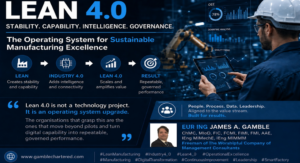
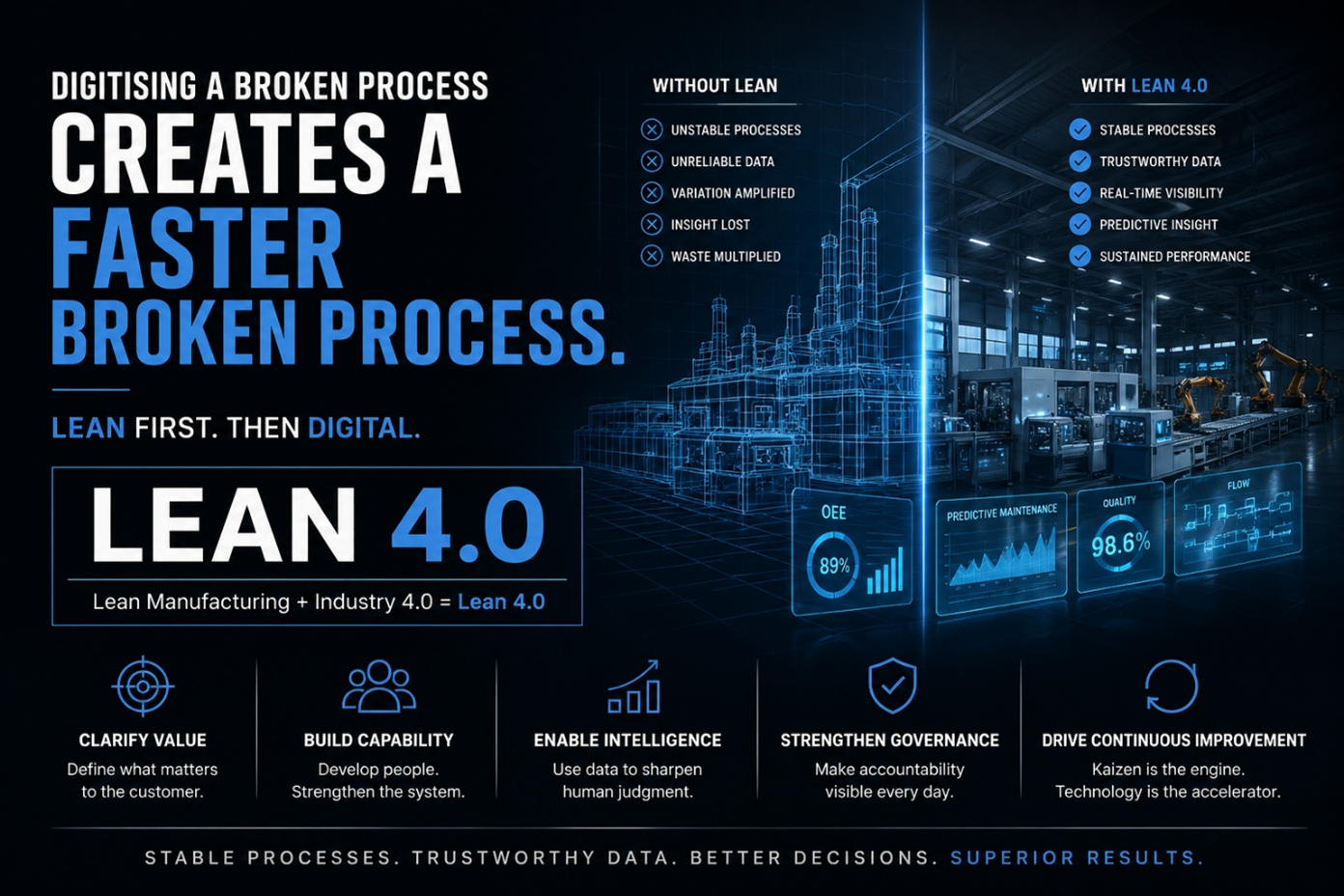
By 2026, the verdict is clear as Industry 4.0 does not replace Lean. It extends it. The convergence of the two, which is often called Lean 4.0, has become the gold standard for high‑performance, high‑governance manufacturing.
1. Lean Creates Stability, Industry 4.0 Scales It
Lean’s first responsibility is to stabilise the system:
- Standard work.
- Flow and Takt alignment.
- Visual management.
- Problem solving discipline.
- Waste elimination.
These are not pre‑digital housekeeping tasks. They are the preconditions for meaningful digital transformation.
Industry 4.0 tools such as IoT sensors, MES, digital twins and AI driven optimisation depend on:
- Repeatable processes.
- Trustworthy data.
- Clear cause‑and‑effect relationships.
Without these, data becomes noise, dashboards become wallpaper and advanced analytics simply reveal how unstable operations really are.
However, done well Industry 4.0 becomes a scaling engine for Lean. Stable processes becoming visible in real time, deviations are detected earlier and countermeasures can be deployed faster and more consistently across sites and lines.
2. From Physical Gemba to Digital Intelligence
Lean has always been about eliminating waste and maintaining flow. Traditionally, this meant Gemba walks, whiteboards, clipboards and paper value stream maps. Industry 4.0 converts this into a real‑time, data‑rich discipline.
Digital Value Stream Mapping (DVSM)
Digital twins now create living replicas of the factory. Real‑time data highlights:
- Emerging bottlenecks.
- WIP accumulation.
- Sources of delay or rework.
This moves organisations from ‘we think the bottleneck is possibly here’ to ‘we know, right now, exactly where flow is breaking down.’
TPM 4.0 and Predictive Maintenance
Total Productive Maintenance once relied on time based schedules and operator intuition. With IoT, machines stream vibration, temperature, pressure and performance data to predict failures before they occur, turning unplanned downtime into planned micro‑stoppages and surgical interventions.
The principle hasn’t changed to protect flow and equipment health but the speed and precision of waste elimination has increased dramatically.
3. Lean Builds Capability, Industry 4.0 Builds Intelligence
Lean develops people who understand:
- How the process behaves.
- Where variation originates.
- How to solve problems at the right level.
- How to maintain flow under pressure.
Industry 4.0 then adds:
- Real time visibility.
- Predictive capability.
- Automated decision support.
- System level optimisation.
However, the sequence does matter.
As AI cannot fix what leadership does not understand. Automation cannot stabilise what operators cannot control. Dashboards cannot compensate for the absence of problem solving discipline.
Digital maturity is not a software problem. It is a capability problem. The organisations that are most successful are those that marry deep process understanding with advanced analytics that use data to sharpen human judgment, not replace it.
4. JIT, Jidoka and the Augmented Workforce (foundational pillars of the Toyota Production System)
Lean and Industry 4.0 are often mimicked as simplicity vs. complexity. In reality, Lean 4.0 uses digital tools that reinforce core Lean concepts.
Kanban
- Traditional: physical cards and bins.
- Industry 4.0: RFID, e‑Kanban, cloud based replenishment across suppliers and warehouses.
Jidoka (autonomation)
- Traditional: people stop the line when they detect a defect.
- Industry 4.0: AI powered computer vision stops the process instantly before defects move downstream.
Poka‑Yoke (error proofing)
- Traditional: fixtures, guides, checklists.
- Industry 4.0: AR overlays guiding operators step‑by‑step, reducing cognitive load and training time.
Heijunka (level loading)
- Traditional: manual planning boards.
- Industry 4.0: AI driven scheduling based on real time demand, capacity and constraints.
Lean 4.0 does not replace people. It augments them. Collaborative robots handle repetitive, ergonomically challenging tasks. People focus on Kaizen, creative problem solving and system design. Areas where human judgment remains irreplaceable.
5. Lean Clarifies Value, Industry 4.0 Accelerates It
Lean forces organisations to define value with precision:
- What does the customer truly care about?
- Where is value added in the flow?
- Where does waste accumulate?
Industry 4.0 then accelerates value delivery by:
- Reducing information latency.
- Increasing responsiveness.
- Enabling end‑to‑end traceability.
- Improving decision quality.
However, without clarity of value, digital tools simply make the wrong things faster. We optimise local efficiencies instead of system level performance and risk investing heavily in capabilities customers will not pay for.
6. Lean Strengthens Governance, Industry 4.0 Strengthens Assurance
Lean embeds governance into daily operations:
- Layered accountability.
- Visual control.
- Standardised decision making.
- Clear escalation pathways.
- Daily management at the Gemba.
Industry 4.0 enhances this operating system with:
- Automated data capture.
- Digital audit trails.
- Real time compliance monitoring.
- Predictive risk identification.
- Cross‑functional visibility across plants and suppliers.
This is the future of manufacturing, a governance aligned operating system where Lean discipline and digital intelligence reinforce each other, every shift of every day.
7. The Path Forward, Lean First and then Digital
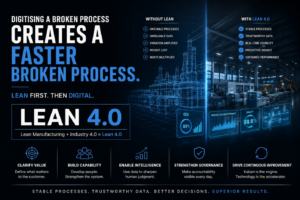
The most important lesson of the 2020s is digitising a broken process only creates a faster broken process.
The organisations pulling ahead follow a consistent pattern:
1. Clarify value and problems using Lean.
Value stream mapping, Gemba walks and A3 thinking.
2. Stabilise and simplify key processes.
5S, standard work, visual management and robust problem solving.
3. Add targeted digital capabilities.
Predictive maintenance for uptime, in‑line quality for First Time Quality, e‑Kanban for flow, digital twins for complex bottlenecks.
4. Build people capability alongside technology.
Upskill operators, supervisors and leaders to interpret and act on digital insights.
5. Institutionalise continuous, data driven improvement.
Integrate real time data into daily huddles, A3s and strategy deployment.
This is Lean 4.0 in practice.
A Leadership Call to Action
For any executive teams, the key questions are really no longer about which technology to buy but whether the organisation is ready to use it well:
- Are our processes stable enough for digital enablement?
- Do we have the capability to interpret and act on digital insights?
- Is our data structured, trusted and aligned to the value stream?
- Are we investing in technology before investing in discipline?
Industry 4.0 is not a technology race. It is a systems thinking challenge.
The winners in the next decade will not be the most automated factories. They will be the most stable, capable and governed. Where Lean is the operating philosophy, Industry 4.0 is the enabling infrastructure, data is an engineered asset and AI is a capability multiplier rather than a substitute for discipline.
For transparency, these reflections are my own and draw on years of cross sector experience, not on any single engagement, employer or client.
James Gamble
23/06/2026