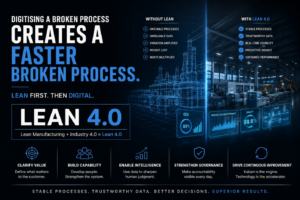
In my previous article on Lean Manufacturing, ‘Industry 4.0 and the rise of Lean 4.0’, I discussed that digitising a broken process only creates a faster broken process. Lean creates stability and capability and Industry 4.0 then scales and amplifies it.
That point did resonate with some as the challenge became, even when organisations accepted this strategy, not to run into a new issue where lots of promising pilot runs are maintained.
The pattern is familiar:
• A predictive maintenance ‘proof of concept’ that saves a week of down time then stays on one machine.
• A digital quality system that catches defects early but doesn’t become the standard way of working.
• A control room with real‑time KPIs that become a metric wallpaper rather than the centre of daily management.
The issue is therefore rarely that the technology doesn’t work but that the organisation has not yet changed how it works.
Lean 4.0 asks leaders to do something harder than approving a budget for equipment and software. It asks them to treat digital as an extension of their operating model, not a parallel system.
As such, below are five common failure modes I see in Lean 4.0 initiatives and the patterns that help organisations break through the piloting barrier.
1. Tool First Thinking vs. Issue First Thinking
Many Lean 4.0 journeys still start with a vendor demonstration rather than an issue scope.
The conversation sounds like:
• ‘We need an AI solution for maintenance.’
• ‘We should have a digital twin.’
• ‘Everyone else is implementing advanced analytics.’
What is missing is a sharp delivery of the business issue and value stream:
• Which specific downtime modes are hurting service and OEE?
• Where exactly in the flow is quality risk still escaping to the customer?
• Which planning or scheduling decisions most often break flow?
When we start with the tool, we retrofit an issue to justify it. When we start with an issue, Lean 4.0 becomes a targeted intervention within the value stream.
Organisations that scale Lean 4.0 consistently do three things up front:
• Use classic Lean diagnostics (Gemba, A3 problem solving, value stream mapping) to define the issue in operational terms.
• Quantify value in language that the business cares about such as service, margin, risk, safety & compliance.
• Select digital enablers that attack the root cause, not the effect.
In other words, ‘AI for maintenance’ becomes more ‘eliminate unplanned stoppages in this critical asset’ and the technology stack then follows.
2. Local Proof Projects vs. Coherent Operating System
The second failure mode is fragmentation.
Every site has its own proof project:
• A flagship plant with a sophisticated digital control room.
• Another experimenting with eKanban and RFID.
• A third building its own homegrown analytics dashboard.
Individually, these projects may be impressive. Collectively, they create an inconsistent operating system. What one site learns is not easily transferrable to another as data definitions do differ, ways of working differ and governance differs.
The result is that Lean 4.0 becomes more of a patchwork of local initiatives rather than a coherent way of running the business.
Organisations that escape this trap treat Lean 4.0 as an operating model, not a series of apps. As such, they:
• Define a small number of standard ‘digital work practices’ that every site must adopt (for example: digital daily management, standard OEE definitions & common root cause templates).
• Build a simple, shared data model linked to the value stream (assets, products, defects, downtime reasons & changeovers).
• Use a central enablement team to codify and scale proven patterns, rather than reinventing them in every plant.
Therefore, the question shifts from ‘What’s our digital project?’ to ‘How consistently are we running our Lean 4.0 operating system across the network?’
3. Fancy Dashboards, Traditional Behaviours
A third and quieter failure mode is behavioural. Where digital tools are deployed but leadership practises do not change.
Therefore, we still see:
• Daily meetings that talk about numbers, not causes or countermeasures.
• Escalation that happens by email and private conversations, not via standard mechanisms.
• Leaders who still ‘walk the floor’ physically but rarely ‘walk the data’ with their teams.
Within these environments, dashboards become an exercise in reassurance rather than a management tool.
By contrast, when Lean 4.0 lands well, the behaviours change before technology is finished:
• Daily huddles use real‑time data instead of previous whiteboards.
• Supervisors arrive at the line already knowing where flow is breaking and why.
• Leaders ask different questions, such as ‘What did the data tell us about that stoppage?’ and ‘Which standards are we updating based on this pattern?’.
The significant signs are that data has become an integral part of issue solving conversations, not a separate ‘reporting’ activity.
4. Underestimating the People Side of Digital
A fourth pattern is to treat training as a single handover event from the project team to operations. However, only a few training sessions are delivered, a user manual is written and the assumption is that adoption will take care of itself.
In reality, Lean 4.0 changes:
• How operators interpret what is happening in the process.
• How supervisors prioritise and escalate.
• How engineers analyse patterns and design countermeasures.
• How leaders allocate attention and resources.
This is not just a ‘how to click the system’ change. It is more a capability shift.
Organisations that scale Lean 4.0 invest heavily in three areas of people development:
- Data Literacy for the Frontline: Operators and team leaders learn not only how to read dashboards but how to interpret trends, spot signals and translate them into concrete actions on the line.
- Digital Issue Solving Skills: Classic Lean tools (5 Why, fishbone diagrams, A3 problem solving) are integrated with digital tools (event logs, pareto charts, anomaly detection) so that teams can move seamlessly from symptoms to causes using real‑time evidence.
- Leadership Coaching and Role Modelling: Leaders practice the habit of asking data driven questions, reinforcing standards and protecting time for structured issue solving, rather than reverting to firefighting.
Where this is in place, adoption stops being an afterthought and becomes a core pillar of the transformation.
5. Pilot Runs with No Path to Standardisation
The fifth failure mode is structural.
Pilot runs are launched with enthusiasm but there is no clear mechanism for turning a successful experiment into a new standard across the network.
We see:
• No defined ‘exit criteria’ that says when a pilot run is good enough to scale.
• No single owner accountable for turning lessons learned into standard work, templates and training.
• No governance forum where business leaders explicitly agree to retire legacy ways of working.
The inevitable result is a graveyard of ‘successful pilot runs’ that never become the norm.
A more robust pattern is to treat each pilot run as a ‘design sprint for the future standard’, not a standalone experiment. This means:
• Defining from the outset which elements must be standardised (data definitions, workflows, alerts, visualisations) and which can remain local.
• Capturing not just technical lessons but process and behavioural lessons that changes in daily management, who needs to be involved and where resistance has emerged.
• Having a clear, time bound plan for rollout and change management once the pilot run meets its success criteria.
In other words, we are not just proving that the technology works. We are designing something that the organisation can live with, govern and continuously improve.
From Projects to an Engine, A Practical Blueprint
If we pull these threads together, a practical Lean 4.0 scaling pattern does emerge. Organisations that move beyond the pilot runs tend to follow a disciplined, repeatable path:
- Start with the Value Stream, Not the Vendor: Use Lean diagnostics to prioritise a handful of high leverage issues where digital can materially improve flow, quality, safety or service.
- Design the Future Way of Working, Not Just the System: For each initiative, answer ‘How will this change the daily work of operators, supervisors, engineers and leaders?’ and bake that into the design.
- Standardise the Building Blocks Early: Agree common data definitions, visual conventions and workflows so that insights are comparable across lines and sites.
- Build Capability Alongside Technology: Sequence investments in training, coaching and leadership routines alongside the technical rollout, not six months later.
- Institutionalise the Learnings: After each wave, deliberately convert what worked into standard practices, playbooks and checklists that the next site can adopt faster.
- Govern Like an Operating System, Not a Project Portfolio: Move leadership forums from reviewing individual projects to reviewing how well the Lean 4.0 operating model is embedded through stability, capability, governance and improvement.
A Leadership Call to Action, Treat Lean 4.0 as an Operating Model
The main question for any executive team is no longer whether Industry 4.0 is relevant but instead:
• Have we defined Lean 4.0 as the way we run operations, or as a collection of interesting pilot runs?
• Are we willing to retire legacy ways of working and make digital practices the standard, not the exception?
• Are our leaders prepared to change their own routines on how they review performance, how they coach, how they make decisions and to fully leverage digital intelligence?
• Do we understand that every dashboard, sensor and algorithm is ultimately a design choice about our operating model?
Our winners in the next decade will not be the factories doing the most pilot runs, the flashiest control rooms or have the largest technology budgets.
They will be the factories where:
• Lean disciplines are non‑negotiable.
• Industry 4.0 is tightly coupled to the value stream.
• Data is engineered as an asset, not an afterthought.
• Leadership treats digital not as a side project but as an upgrade to how the entire system thinks, learns and improves.
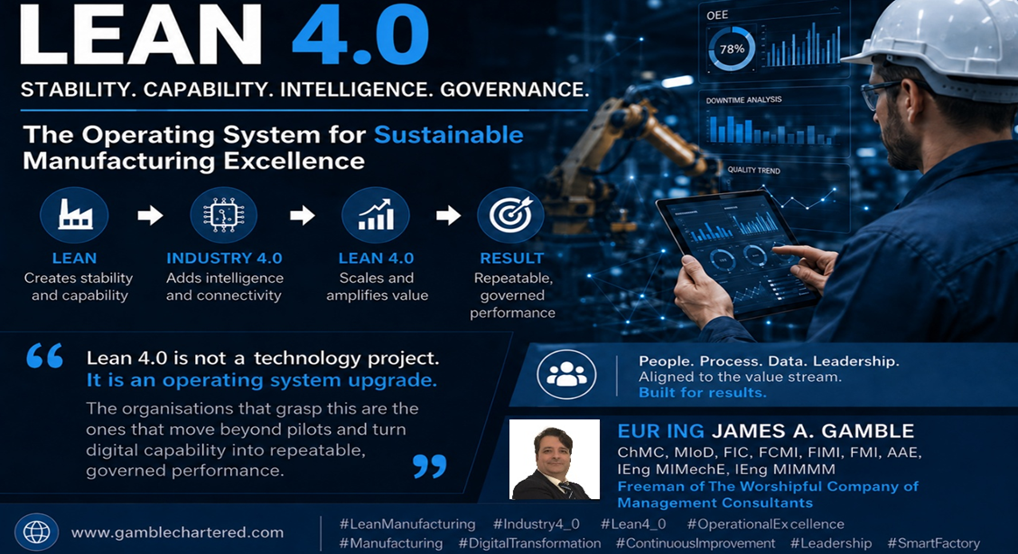
Lean 4.0 is the convergence of these elements with stability, capability, intelligence and governance converted into a single, coherent operating system.
Those who master that convergence will not just have successful pilot runs. They will have a scalable, resilient advantage.
If you’d like to explore what this can look like in context from structuring pilot runs to defining a Lean 4.0 operating model, I’d be interested to hear from others working in manufacturing.
For transparency, these reflections are my own and draw on years of cross sector experience, not on any single engagement, employer or client.
James Gamble 14/07/2026