In modern engineering, transformation and organisational leadership. One principle that consistently separates high performing enterprises from those trapped in cycles of inefficiency, rework or avoidable failure is traceability.
Too often, traceability is misunderstood as an administrative burden via a compliance exercise performed reluctantly and only when auditors, regulators or quality teams demand it. This mindset is not only outdated, it is strategically damaging. When treated as paperwork, traceability does become a cost. When treated as a leadership discipline, it becomes a force multiplier.
Traceability, when embedded properly, creates clarity, accelerates decision making, reduces waste and provides the evidential backbone for continuous improvement. It is the connective tissue that links intent to execution, execution to outcome and outcome back to learning, creating what could be considered a form of organisational CPD (Continuous Professional Development).
Over years of leading complex engineering programmes, quality investigations and organisational stabilisation efforts. I have developed a practical, leadership ready framework for applying traceability across the full lifecycle of work. I call this ‘The Gamble Traceability Protocol’.
What is ‘The Gamble Traceability Protocol’:
‘The Gamble Traceability Protocol’ is my structured methodology for ensuring that every critical decision, action, requirement, change and outcome within a business or programme can be traced clearly and unambiguously.
It is not a document. It is not a template. It is a discipline and a way of operating that ensures organisations understand:
- Why work is being done.
- What decisions were made.
- Who is accountable.
- How changes were controlled.
- Whether the outcome delivered the intended value.
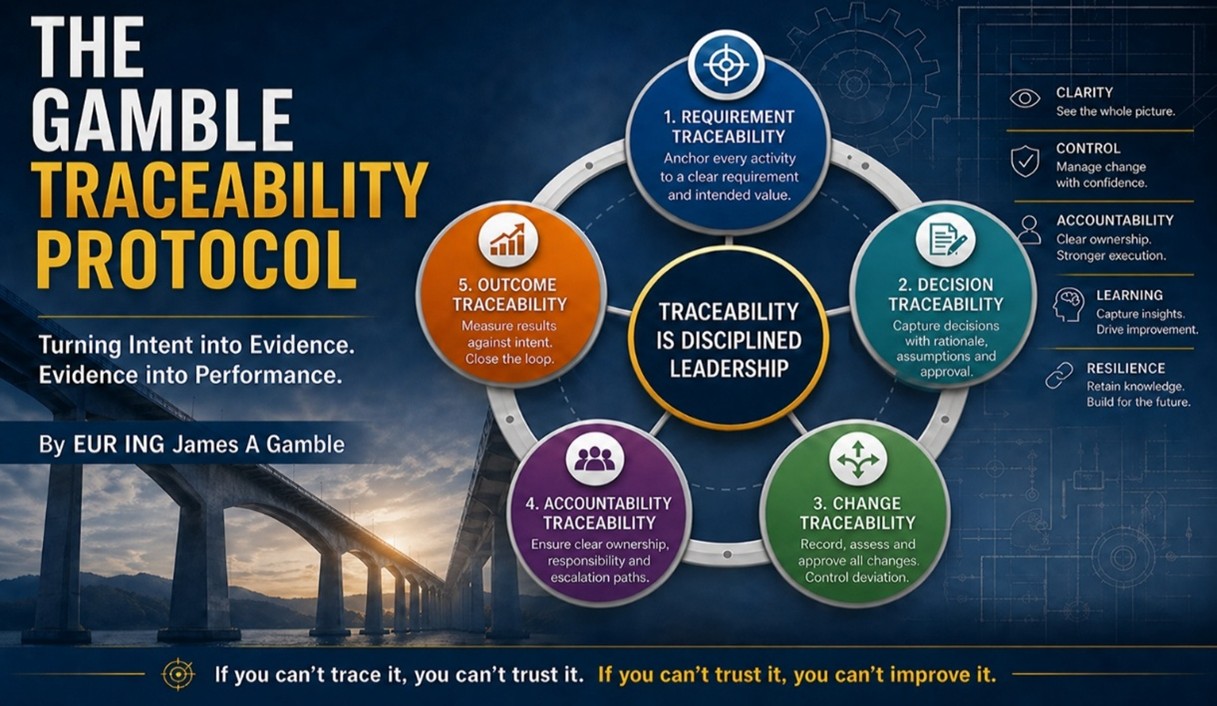
The protocol is built on five core pillars.
1. Requirement Traceability.
Every activity must begin with a clearly defined requirement. Requirements are the anchor point for value, scope and intent. If a task, project or decision cannot be linked to an agreed business, customer, technical or regulatory requirement. Its value should be challenged.
This pillar prevents scope creep, misalignment and ‘busy work’ that consumes resources without delivering meaningful outcomes.
Key Principle: If we cannot trace it to a requirement, question why it exists.
2. Decision Traceability.
Critical decisions must be recorded with rationale, assumptions, constraints and approval authority. This is not bureaucracy, it is organisational memory.
When decisions are not captured, teams lose context. New leaders inherit outcomes without understanding the reasoning behind them. Therefore, investigations become slower as accountability becomes blurred. Over time, organisations repeat avoidable mistakes because they cannot see the logic that originally led them.
Key Principle: Good decisions leave evidence.
3. Change Traceability.
Any deviation from baseline whether its technical, commercial, operational or strategic must be logged, reviewed and approved. Uncontrolled change is one of the most common root causes of programme failure in my eyes.
Change traceability ensures that leaders understand the impact of deviations, that risks are found early and that the organisation remains aligned on what ‘good’ looks like.
Key Principle: Unrecorded change is unmanaged risk.
4. Accountability Traceability.
Ownership must be explicit. Every deliverable, decision and action must have a named owner. Responsibility matrices, governance structures and escalation paths must align so there is no ambiguity.
When accountability is unclear, work slows, decisions stall and quality deteriorate. When accountability is clear, organisations move with confidence and pace.
Key Principle: If everyone owns it, no one owns it.
5. Outcome Traceability.
Final results must be measurable against the original requirement and intended business objective. Without this feedback loop, organisations cannot learn, cannot improve and cannot reliably predict future performance.
Outcome traceability closes the loop between intent and reality. It is the foundation of continuous improvement and the antidote to ‘activity without impact’.
Key Principle: Every output must connect back to intended value.
Why It Matters:
In complex organisations, failure rarely stems from a single mistake. More often, it emerges from:
- Fragmented decisions.
- Undocumented assumptions.
- Weak governance.
- Poor visibility between cause and effect.
- Misaligned expectations.
- Uncontrolled change.
- Loss of organisational memory.
As such, ‘The Gamble Traceability Protocol’ addresses these systemic weaknesses by creating:
- Clarity: Everyone understands why work is being done.
- Control: Changes are visible, governed and intentional.
- Accountability: Ownership is explicit and enforceable.
- Learning: Root causes become identifiable and actionable.
- Resilience: Knowledge is retained, not lost when people move on.
Traceability is not about slowing work down. It is about enabling work to move faster, cleaner and with greater confidence.
Applying the Protocol Beyond Engineering:
Although the protocol was born from engineering and programme leadership, its principles apply universally across complex organisations. It strengthens:
- Business transformation programmes.
- Operational excellence initiatives.
- Consultancy engagements.
- Strategic planning cycles.
- Risk management frameworks.
- Regulatory and compliance environments.
- Digital and data governance.
- Mergers & Acquisitions integration programmes.
- Safety critical operations.
- Supply chain and vendor management.
Any organisation operating at scale or complexity benefits when traceability becomes a leadership discipline rather than a paperwork exercise.
What Leaders Often Miss:
Three misconceptions consistently undermine traceability:
1. ‘We don’t have time to document everything’
Traceability is not about documenting everything, it is about documenting the critical things. The cost of not doing so is always higher.
2. ‘Traceability is a quality function’
Quality may control it but leadership must own it. Traceability is a governance discipline, not a departmental task.
3. ‘We already have processes for this’
Most organisations have processes. Few have discipline. The protocol strengthens the latter.
Final Thought:
Traceability is not bureaucracy, it is disciplined leadership.
The organisations that master traceability do not merely document better, they execute better, learn faster and fail less often. In my experience, when traceability is embedded properly, performance improves not because people work harder but because the system becomes clearer, smarter and more accountable.
That is the essence behind ‘The Gamble Traceability Protocol’.
As such, how does your organisation approach traceability and is it treated as compliance, or as a strategic advantage?
For transparency; all reflections are my own and draw on years of cross-sector experience not on any single engagement, employer or client.
James Gamble
27/04/2026